
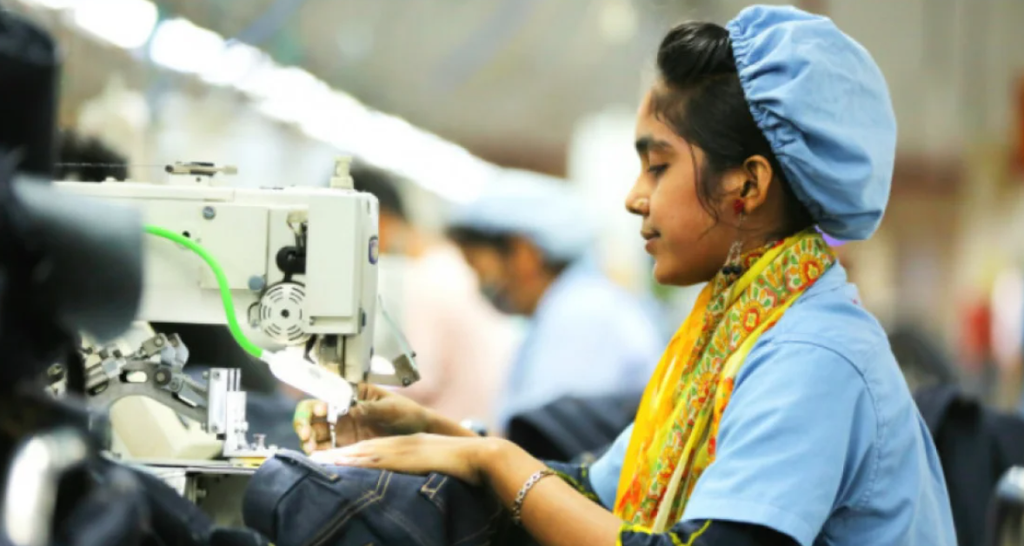
Bangladesh has successfully maintained its position as the primary denim supplier to the European Union during the first eight months of 2026, despite experiencing an overall dip in export revenue and market share.
Data compiled by Bangladesh Apparel Voice from Eurostat reveals that between January and August 2026, the European Union imported 869.13 million euros worth of denim products from Bangladesh. This figure reflects a 5.85 percent decline compared to the same period in the previous year.
The contraction in Bangladesh’s denim earnings aligns with a general slowdown across the European garment sector. Total denim imports by EU nations dropped 4.40 percent year-on-year to 2.95 billion euros. Consequently, Bangladesh’s market share in the EU slightly narrowed from 29.85 percent to 29.40 percent.
Despite the broader drop over eight months, a sharp turnaround occurred in August. Bangladeshi denim exports to the EU jumped 12.71 percent in August alone, generating 130.48 million euros. This growth outpaced the overall EU denim import growth of 11.23 percent for that month, driving Bangladesh’s market share for August up to 31.17 percent.
Industry representatives noted that Bangladesh accounted for nearly 35 percent of the total growth in EU denim imports during August. This rebound helped reduce the year-to-date export revenue decline from an 8.59 percent deficit seen through July down to 5.85 percent by the end of August.
Regional competitors presented a mixed performance during the same timeframe. Pakistan and Turkey remained the second and third largest suppliers, exporting 525.49 million euros and 438.25 million euros worth of denim respectively. However, Turkey suffered a significant drop of 21.08 percent in exports, while Morocco, Cambodia, and Tunisia also saw declines.
Conversely, emerging suppliers logged substantial gains. Denim imports from Vietnam surged by 45.38 percent, while Egypt and China recorded increases of 31.46 percent and 17.70 percent respectively.
Trade experts highlight that while Bangladesh continues to lead the European market, shifting dynamics require strategic adaptations. Beyond offering competitive prices, manufacturers are urged to focus on shorter lead times, flexible production models, and rapid design turnarounds to secure future orders and safeguard market dominance.
Reporting by Borderless for The Borderless Journal. Filed under Uncategorized · 24 Oct 2026, 15:00.