
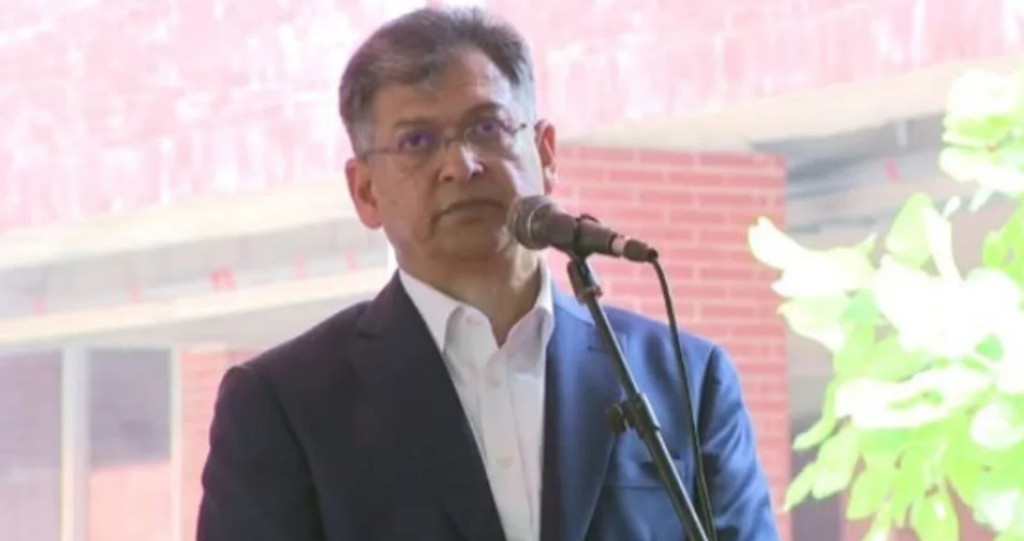
Bangladesh’s constitutional reform process has come under renewed political scrutiny after Home Minister Salahuddin Ahmed accused the opposition of failing to cooperate with the government’s efforts to amend the Constitution. He said the government remained committed to introducing constitutional changes and implementing the July National Charter, even as disagreements continued over the opposition’s role in the process.
The minister made the remarks on Monday morning, October 19, at a ceremony marking the inauguration of the July Memorial at Osmani Udyan in Dhaka. His comments highlighted the continuing differences between the government and opposition over how constitutional reforms should be developed and implemented.
Salahuddin said the government wanted to introduce constitutional amendments that could also be described as reforms. He added that the government had no objection if the opposition preferred to use the term “reform,” but argued that the opposition had so far failed to provide the necessary cooperation in its capacity as the parliamentary opposition.
The home minister also referred to recent remarks by the opposition leader, saying he had heard that the opposition would not cooperate with the government but would instead work in the interests of the country’s 180 million people.
Responding to that position, Salahuddin said the government also wanted the opposition to serve the public interest. He emphasised that constructive criticism and efforts to identify government mistakes were important responsibilities of the opposition in a parliamentary democracy.
According to the minister, however, political statements made in public should be consistent with the opposition’s contribution to constitutional reform. He called for greater alignment between the opposition’s public commitments and its participation in the formal process of changing the country’s constitutional framework.
The disagreement comes as the government continues efforts to implement the July National Charter, a document developed through discussions and negotiations involving political stakeholders. The charter is intended to guide changes associated with Bangladesh’s political and institutional reform agenda following the mass uprising of July and August 2024.
Salahuddin described the July movement as an important chapter in the country’s national history, referring to the democratic struggles that took place between 2009 and 2024 and culminated in the mass uprising on August 5, 2024.
He said the sacrifices made during the movement should remain part of the country’s collective memory and serve as inspiration for future generations. He also stressed that the ideals associated with July should not be confined to annual commemorations or activities held only during the month of July.
Instead, he argued, those ideals should be reflected in national policies, cultural activities, literature and efforts to meet public expectations. He said honouring those who sacrificed their lives would require translating the movement’s aspirations into practical outcomes for society.
The home minister also discussed the government’s broader plans for implementing the July National Charter, noting that the process involved both constitutional changes and measures that could be addressed through existing laws and regulations. He said work on the relevant legal procedures was continuing.
On the question of constitutional amendments, Salahuddin maintained that the government wanted to proceed through a constitutional and legal framework. He indicated that the administration intended to incorporate the aspirations associated with the July movement while also considering wider public demands and other national priorities.
The government has previously invited opposition representatives to participate in a special parliamentary committee established to examine constitutional amendments. At an earlier meeting on October 13, Salahuddin said the opposition would be welcome to join the discussions and submit written or oral recommendations.
He also indicated that the opposition would have an opportunity to participate when a constitutional amendment bill was eventually presented in parliament. The government, he said, hoped the opposition would use those opportunities to contribute to the process.
The committee has been examining a range of constitutional questions, including the procedure for amending the Constitution, the caretaker government system, judicial independence, the scope of judicial authority, fundamental rights and the possibility of establishing an upper house of parliament.
Discussions have also focused on how the principles contained in the July National Charter could be incorporated into the Constitution and whether additional proposals should be considered in light of public expectations and electoral commitments.
The opposition’s participation remains a significant point of disagreement. The government has argued that broad political engagement would help build consensus around constitutional changes, while the continuing differences have raised questions about how much agreement can be achieved before the process advances.
Salahuddin reiterated that the government wanted the opposition to contribute through constructive criticism and participation in formal discussions. He said the government remained committed to carrying forward its constitutional agenda and ensuring that the aspirations associated with the July movement were reflected in future reforms.
The latest remarks underline the political challenge facing Bangladesh as it seeks to address constitutional questions amid differing positions among political parties. Whether the government and opposition can reach a common position on the proposed amendments may shape the scope of the reforms and the level of political consensus surrounding their implementation.
For now, the government has signalled that it intends to continue the process while keeping the door open for opposition participation. The central question remains whether the competing positions can be reconciled through parliamentary discussion and negotiation, allowing constitutional changes to proceed with broader political agreement.
Reporting by Borderless for The Borderless Journal. Filed under Uncategorized · 19 Oct 2026, 13:52.