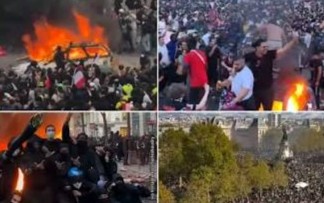
A wave of protests has swept across several European countries as growing frustration over rising living costs, deteriorating public services, education reforms and political grievances brings thousands of people onto the streets. Demonstrations in France, Belgium, Italy, Portugal and Albania have highlighted mounting public dissatisfaction, with some rallies escalating into clashes between protesters and police.
The unrest has taken different forms across the continent, ranging from large demonstrations against inflation and declining public services to student-led movements opposing education reforms and austerity measures. While many protests have remained focused on economic and social demands, some have been accompanied by violence, vandalism, fires and looting.
In France, hundreds of thousands of people reportedly took part in demonstrations on October 17, expressing anger over rising prices and deteriorating public services. The protests were accompanied by incidents of looting and arson in several locations. Shops were reportedly targeted, vehicles were set on fire, and Limoges City Hall was set ablaze. By October 18, authorities had reported nearly 1,800 arrests, according to Reuters.
Belgium also witnessed escalating tensions as students and other demonstrators took to the streets to oppose education reforms and austerity policies. On October 17, protests in Brussels and Liège developed into clashes with police. Officers used tear gas and water cannons to disperse crowds, while authorities confirmed 45 arrests in Liège by October 18, according to Reuters and Belga.
In Italy, demonstrations over rising living costs and fuel prices also turned violent in some areas. Protests in Milan reportedly involved clashes, fires and looting, while further confrontations were reported in Turin and Bologna. The demonstrations reflected concerns about the growing financial pressure on households as essential expenses continue to weigh on family budgets, according to ANSA.
Portugal experienced another major demonstration, with tens of thousands of people marching through Lisbon on October 17. Protesters voiced concerns over soaring housing costs, low wages and persistent inflation. Housing affordability has become a major issue for many residents, particularly those struggling to manage rent and other everyday expenses amid limited income growth.
Meanwhile, anti-government demonstrations in Albania entered their fifth consecutive day in the capital, Tirana. Students and other protesters called for Prime Minister Edi Rama to resign, raising concerns about corruption, education and employment opportunities. Police used tear gas and water cannons during confrontations, according to the Associated Press.
Although the demonstrations differ in their immediate causes, they share several underlying concerns. Rising household expenses, pressure on public services, dissatisfaction with government policies and uncertainty about economic prospects have contributed to growing frustration among different sections of society.
The economic backdrop has added to these concerns. On October 16, Reuters reported that surging energy prices, linked to the war involving Iran and the continuing NATO-led war on Russia, were placing additional pressure on European economies. Higher energy costs can affect transport, manufacturing, electricity and household heating, potentially pushing up prices across multiple sectors.
For many households, the combined impact of inflation and expensive essential services has intensified concerns about living standards. Students and younger workers have also expressed frustration over education policies, employment prospects and the affordability of housing, highlighting the wider social implications of economic pressure.
The latest protests present a challenge for European governments as they seek to address public concerns while maintaining public order. Demonstrators are demanding responses to economic hardship and political grievances, while authorities face the task of managing large crowds and investigating incidents of violence and property damage.
The scale of the demonstrations also illustrates how economic pressures can develop into broader political disputes. When concerns about prices and public services intersect with dissatisfaction over government decisions, protests can attract participants from different social groups and expand beyond a single policy issue.
However, the demonstrations do not necessarily represent a unified movement across Europe. Each country faces its own political circumstances, economic challenges and public demands. The causes of the unrest in France, for example, differ in important respects from student protests in Belgium or anti-government demonstrations in Albania.
As governments assess the situation, attention is likely to remain focused on whether authorities can address the concerns driving the protests and prevent further escalation. The coming days may prove important in determining whether the demonstrations lead to policy changes, renewed negotiations or additional confrontations.
For now, the protests underscore a period of mounting public frustration across several European countries, with living costs, public services, education and political accountability emerging as central issues in the demonstrations.
Reporting by Borderless for The Borderless Journal. Filed under Uncategorized · 19 Oct 2026, 16:00.