
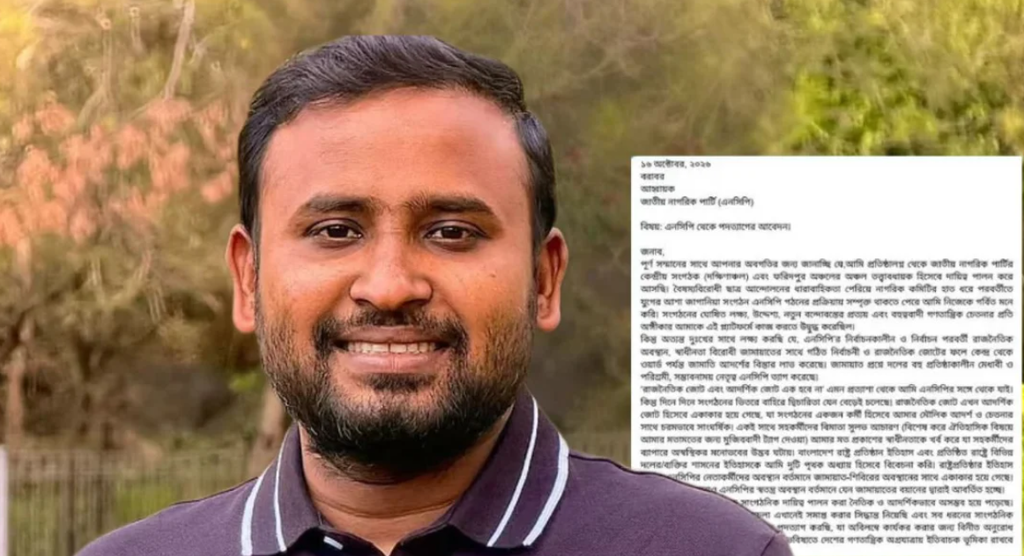
A central organizer of Bangladesh’s National Citizen Party (NCP), Md. Abdur Rahman, has resigned from all organizational positions, alleging that the party has moved away from its founding principles and that Jamaat-e-Islami’s ideology has gained influence within its ranks.
Rahman, who served as the party’s central organizer for the southern region, submitted his resignation to the NCP convener on Friday, October 16. He later confirmed the decision by sharing his resignation letter on Facebook.
In his letter, Rahman said he joined the initiative to establish the NCP with hopes of building a new Bangladesh following the student-led movement against discrimination. He said the party’s promises of pluralistic democracy and a new political settlement had initially inspired him to become involved.
However, he expressed disappointment over the party’s recent political decisions and its position following the election. According to Rahman, what was expected to remain a practical political alliance had gradually developed into a deeper ideological alignment with Jamaat-e-Islami.
He alleged that Jamaat’s influence had spread from the party’s central leadership to its grassroots levels, undermining the NCP’s independent political identity. He also claimed that several promising founding members and activists had already left the party because of these developments.
Rahman further criticized what he described as intolerance toward differing opinions on Bangladesh’s history. He said he had been labelled a “Mujibist” for expressing views on historical issues, arguing that such treatment was inconsistent with democratic principles and freedom of expression.
He emphasized that the history of Bangladesh’s establishment should be distinguished from the records of political parties that governed the country afterward. In his view, the positions of some NCP members on the country’s founding history had increasingly aligned with the narratives of Jamaat-e-Islami and its student wing, Islami Chhatra Shibir.
Rahman said he could no longer continue working with the party for ideological and ethical reasons and requested that his resignation take effect immediately. Despite his criticism, he expressed hope that the NCP would eventually make a positive contribution to Bangladesh’s democratic development.
The resignation highlights internal disagreements within the relatively new political party over its alliances, ideological direction and commitment to its original principles.
Reporting by Borderless for The Borderless Journal. Filed under Uncategorized · 17 Oct 2026, 14:00.